Pothos plants are perennial, tropical plants, easily identifiable by their waxy, heart-shaped leaves, and trailing vines. In most varieties, pothos leaves are streaked or spotted with patches of yellow or white. Pothos plants make exceptionally easy-to-grow houseplants as they prefer low-light environments and do not require much maintenance. In fact, the Royal Horticultural Society has awarded pothos plants the Award of Garden Merit (AGM) for their ability to thrive in a range of growing conditions, despite being natively tropical. Here you find a collection of our favorite types of pothos plants as well as some fascinating facts about these stunning, hardy houseplants.

About Pothos Plants

Pothos is a genus of climbing plants and a member of the Araceae family that thrives in tropical climates. They’re prizes for their ornamental value and there’s a great selection of intriguing variegated pothos cultivars to be found as well.
The scientific name for pothos plants is Epipremnum Aureum, the ‘epi’ portion of which is derived from the Latin word for “stem”. It is thought that pothos plants were given this name as they are typically found growing around tree trunks and branches.
The fact that pothos plants grow naturally in shady, forested areas makes them highly successful houseplants. However, there are considerable size differences between indoor pothos and their wild-growing counterparts. Outside, pothos plants can easily grow tendrils that reach up to 50 feet in length, whereas indoor plants rarely grow longer than 10 feet.
The pothos plant’s characteristic vines can be trained to climb over doorways, around furniture, or across ceiling hooks, making pothos plants an extremely attractive addition to the home or office.
In fact, pothos is frequently found in open office spaces, hotel receptions, and shopping malls due to their unusual ability to flourish under fluorescent lights.
Pothos Plant Origins and History
Pothos plants are native to the Society Islands of French Polynesia but have since been naturalized in Southeast Asia, China, India, Australia, New Guinea, and several Indian and Pacific Ocean islands.
Due to their fast-growing, invasive nature, pothos plants are often referred to as ‘Devil’s Ivy’. When introduced to new tropical environments, this plant has been known to grow out of control, completely covering tree trunks and forest floors.
This has caused severe ecological damage in the Udawattakele Forest of Sri Lanka and is known to be a risk in forested areas along the South African coast.
Pothos vs. Philodendron: What’s the Difference?

Plants from the genus pothos are often confused with Philodendron plants due to their similar appearance.
Despite being an entirely different genus, Philodendron plants have heart-shaped leaves that appear indistinguishable from pothos leaves to the untrained eye. However, it is through close examination of the leaves that the two types of plants can be told apart.
Philodendron leaves are far more dramatically heart-shaped and have a deeper curve where the leaf meets the stem. The thickness and texture of the leaves are other signifiers. While pothos plant leaves are distinctly thick and waxy, philodendron leaves are typically thinner and softer.
There are also differences between the growing habits of philodendron plants and pothos plants. For instance, philodendron plants grow new leaves from cataphylls which encase budding leaves as they develop. Once the new leaf has unfurled, cataphylls will remain attached to the plant for a short time before dying and falling off. In contrast, pothos plant leaves do not develop in cataphylls but unfurl directly from the last leaf.
It is not essential to be able to tell the difference between pothos and philodendron plants, as the two genus have similar care requirements. In general, they are both considered low-maintenance plants.
However, there are a few subtle differences that should be considered if you want to get the most from your houseplant. For instance, pothos plants tolerate low-light conditions slightly better than philodendrons. When placed in low light, philodendron growth can slow, and leaf size can become stunted. In contrast, pothos plant leaves are rarely affected by low-light conditions.
Popular Types of Pothos Plant to Grow at Home
Pothos plants come in many varieties, each with its own distinct leaf pattern and growing habits. Most pothos varieties can be trained to climb, though others are better suited to planters and pots on tables and dressers.
Though each variety of pothos plants has slightly different care requirements, they are all considered low-maintenance and will thrive in most positions. Here are some of the most popular types of pothos plants to grow at home:
1) Marble Queen pothos (Epipremnum Aureum)
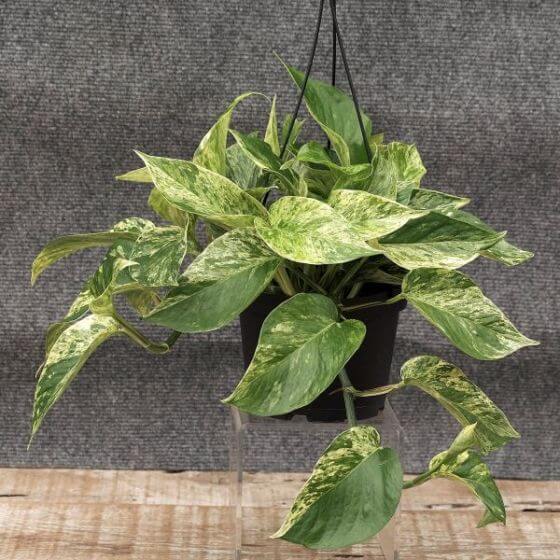
Marble Queen is one of the most popular and visually striking varieties of pothos, thanks to its large, green, and yellow heart-shaped leaves.
This popular houseplant grows in long tendrils and is perfect for hanging baskets. Also a good choice for pots on top of tall pieces of furniture, where its vines can be left to trail.
2) Golden pothos (Epipremnum Aureum)

In color, size, and structure, Golden pothos appear similar to the Marble Queen variety.
The difference between the two types of plants lies in the size and distribution of the yellow flecks on the leaves. In Marble Queen, the flecks are fine and evenly distributed. In Golden pothos, they appear as larger, randomly distributed patches. Like Marble Queen, Golden pothos is best suited to hanging baskets and containers atop tall furniture.
3) Silver pothos (Epipremnum Aureum)

Silver pothos is aesthetically like the Marble Queen and Golden varieties (and also a relative to the famed Scindapsus Treubii Moonlight). However, the flecks of lighter color on the leaves appear more silver than yellow. The leaves themselves are typically smaller.
Silver pothos can be trained to grow over furniture and around doorframes or left to trail from hanging pots.
4) Pothos n’joy (Epipremnum Aureum)
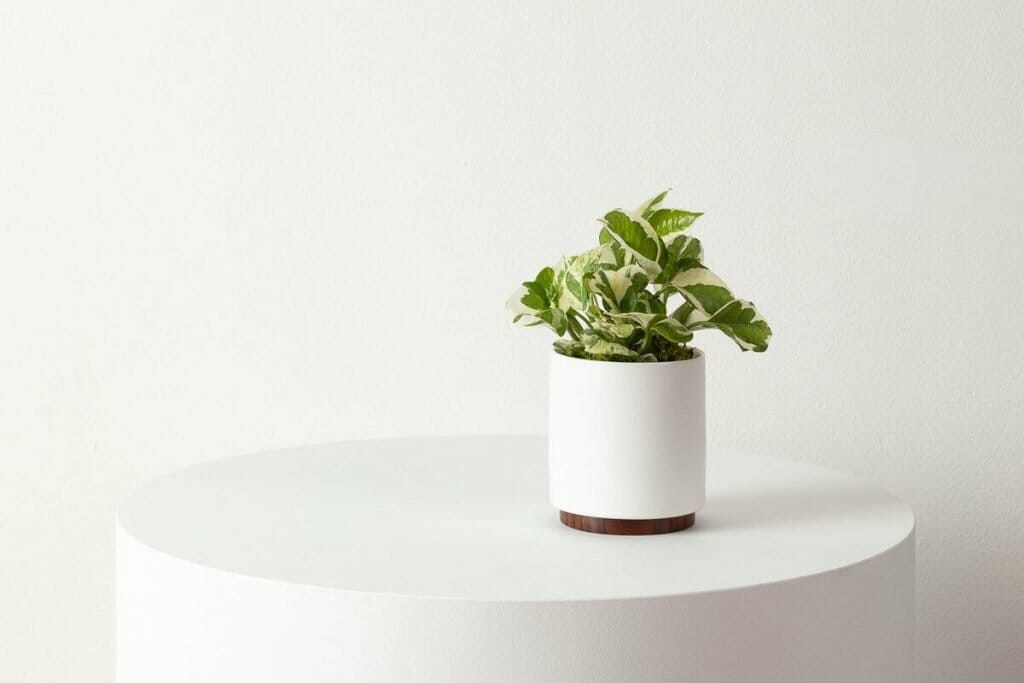
Also known as “pearls and jade”, this variety of pothos has dark green leaves with large distinctive pearl-grey patches. Pothos n’joy grows more slowly than other varieties and makes a great indoor plant for pots on desks, dressers, and tables.
Unlike other types of pothos plants, Pothos n’joy is sensitive to drying out and must be kept in moistened soil.
5) Jade pothos (Epipremnum Aureum)
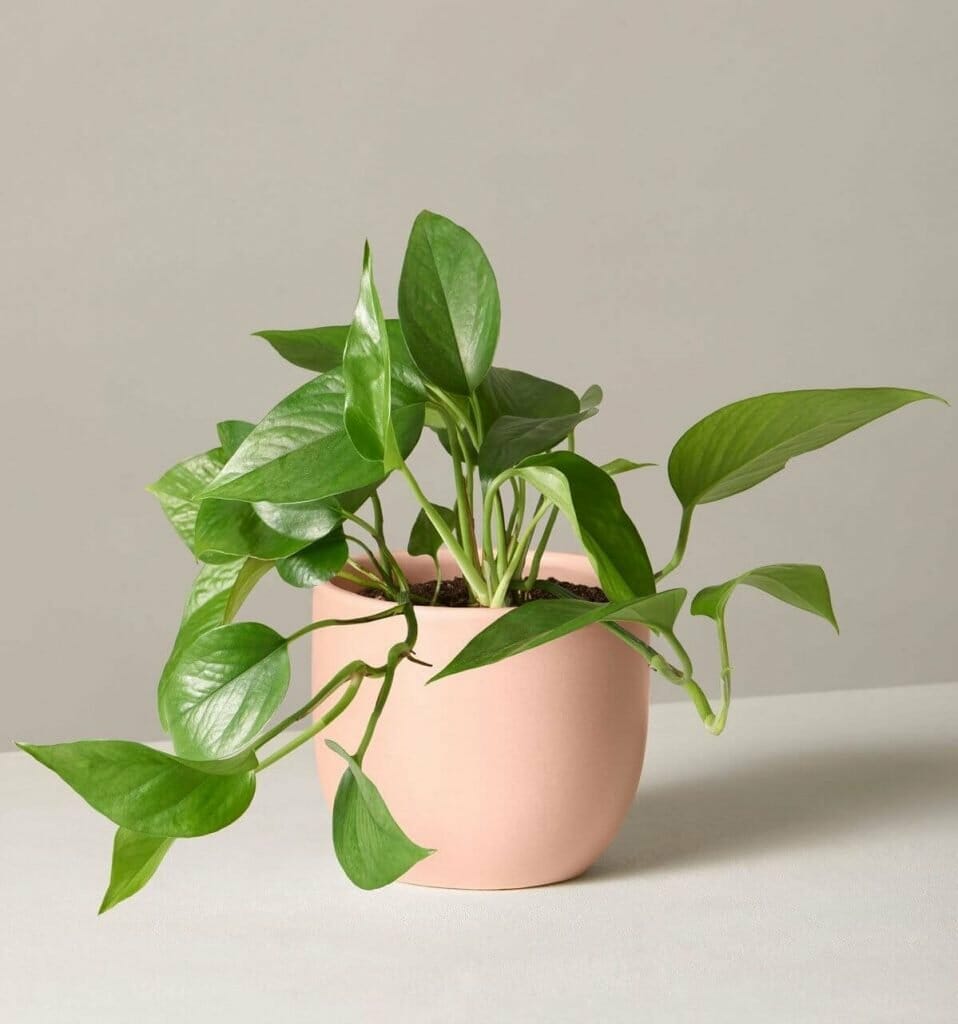
Jade pothos has dark green heart-shaped leaves without the distinctive flecks of other varieties. This type of pothos needs plenty of light to grow but should not be placed in direct sunlight. With its larger leaves and shorter tendrils, Jade pothos is a popular choice for larger floor pots. To create a taller display, this plant can be trained to grow upwards around a centrally planted support.
6) Hawaiian pothos (Epipremnum Aureum)

Hawaiian pothos plants are similar in color to the Golden and Marble Queen varieties but have much larger leaves. This type of pothos makes attractive houseplants and can be trained to grow upwards around a central pole.
More so than any other variety of pothos, Hawaiian pothos prefers humid conditions and should not be placed in direct sunlight.
7) Manjula pothos (Epipremnum ‘Manula’)

The leaves of Manjula pothos are much broader than those of other varieties and have uniquely curved edges. The coloring of this pothos plant is also quite distinctive. The lighter patches on the leaves are a creamy silver color and vary quite dramatically in size. Manjula pothos does not climb as well as other varieties and would be best suited to a floor container or tabletop pot.
8) Neon pothos (Epipremnum Pinnatum)

Neon pothos has heart-shaped leaves typical of the genus. However, this type of pothos does not have the light flecks of yellow or silver seen on most other varieties. Neon pothos is easily recognizable by their vibrantly light green leaves. To keep their bright green appearance, Neon pothos should be grown in a well-lit spot.
9) Satin pothos (Scindapsus Pictus)

Despite its name, Satin pothos is not truly a member of the pothos genus. This plant is aesthetically very like the Marble Queen and Golden pothos, though with silver rather than yellow-flecked leaves. Satin pothos is native to Thailand and the Philippines, where it can grow to a height of three meters.
As a houseplant, Satin pothos is well-suited to high-hanging baskets as it does not climb as well as other pothos varieties.
Satin pothos adapts well to both low-light and well-lit areas, making it an ideal choice for homes without a lot of natural light.
Pothos Plant Uses and Benefits

The vibrant, heart-shaped leaves and sprawling tendrils of most pothos varieties make them a fantastic ornamental addition to any houseplant collection.
As pothos plant vines can be trained to grow around doors and across furniture however you see fit, they work well in practically any space around the home.
Air Purifying Benefits of Pothos Plants
Pothos plants do not only serve an aesthetic purpose – but they also carry numerous beneficial properties. What’s more, these incredible plants are known to be effective air purifiers.
This could be one of the reasons they have been extremely popular houseplants throughout human history. Unlike most plants believed to have air-purifying properties, pothos plants have been the subject of extensive study. In fact, the plant’s air purifying benefits were well documented in a study by NASA.
During this experiment, NASA found that pothos plants significantly reduce the levels of harmful pollutants like toluene, benzene, carbon monoxide, xylene, and formaldehyde in the air.
In addition to being proven air purifiers, pothos plants are known to increase humidity in a room. This can help to protect you from colds, viruses, and allergens, which cannot move quickly in the humid air. Pothos plants also have certain beauty benefits, as humid air helps to keep skin hydrated and supple.
Pothos Plants in Feng Shui
Followers of Feng Shui believe that pothos plants can cleanse their immediate environment of negative energies. According to the principles of Feng Shui, areas of ‘dead space’ such as corners and the tops of high cabinets can accumulate bad energy.
It is also thought that electrical items such as televisions, routers, telephones, and computers can give off radiation that disrupts sleep and increases stress levels.
Feng Shui experts suggest that placing a golden pothos plant in corners or near these appliances can mitigate the effects of this negative energy build-up. This can help to create a happier and more peaceful home environment.
Besides their negative energy and radiation-reducing properties, golden pothos plants have long been symbols of wealth and good fortune.
As such, they are mentioned in the Hindi architectural practice ‘Vastu Shastra’ as a vital addition to any home or office space. It is thought that people who keep healthy pothos plants invite financial success and good luck into their lives.
Pothos Plant Toxicity

Pothos plants have no known medicinal applications. In fact, they contain insoluble, calcium-based raphides, which can be harmful if ingested. These raphides can be so harmful to animals that the American Society for Prevention of Cruelty to Animals (ASPCA) lists pothos plants are toxic to cats and dogs. When consumed, the leaves of pothos plants can cause vomiting, difficulty swallowing, and mouth irritation.
In addition, the plants contain a substance called calcium oxalate, which has a mild toxic effect on humans. In some cases, prolonged contact with pothos leaves can cause skin irritation; if eaten by humans, this substance may also lead to oral swelling and a sensation of burning in the mouth and throat.
Pothos Plants Meanings and Symbolism

In most cultures, Pothos plants symbolize good fortune and wealth. Perhaps due to the plant’s determined growing habits, pothos is also thought to represent longing, a relentless pursuit of success, and the ability to achieve one’s dreams.
As such, these houseplants make a fantastic gift for anybody seeking financial fortune or embarking on an exciting new life venture.
Pothos Plants in Greek Mythology
In Greek mythology, Pothos is the God of desire. It is said that Pothos yearned to become one of the Goddess Venus’ attendant lovers but, despite his unrelenting drive and passion, was never able to fulfill this dream.
While there are undoubtedly some parallels between Pothos in Greek mythology and the symbolism associated with pothos plants, this unfulfilled desire seems to stand in contrast to the positive meaning of the plant. This is perhaps why the Greek myth is rarely mentioned in relation to pothos plant symbolism today.
How to Grow Pothos Plants at Home

Potting Pothos Plants
Pothos plants do not cope well with sitting in soggy soil. It’s essential to choose a pot with drainage holes when planting at home.
Trailing varieties of pothos work well in hanging baskets or pots atop bookcases and cabinets. I’d recommend that slower-growing varieties be potted in traditional tabletop planters or pots.
As pothos plants are known for their rapid growth, most varieties will eventually need re-potting in larger containers every 1 to 2 years.
The Best Soil Mixed for Pothos Plants
Plant your pothos in any well-draining potting mix with a couple of handfuls of perlite to maximize the pot’s draining capacity.
For more, please see our comprehensive guide to the Best Pothos Plant Soil Mix here.
Pothos Plant Light Preferences:
While pothos plants will grow in just about any light conditions. As a general rule, aim for well-lit areas that are not in direct sunlight. Keep in mind that pothos plants are native to tropical regions and, as such, prefer draught-free areas and warmer temperatures.
Caring for Pothos Plants

Watering Pothos Plants
As pothos plants grow natively in humid climates, you can keep them healthy and happy by occasionally misting them with water. Note that soil should be kept barely damp but must not be overwatered.
Generally, experts recommend occasional heavy watering, allowing the soil to almost dry out each time. If the leaves of your plant begin to droop, this could indicate that too much time has been left between each watering.
For more, see our in-depth guide to watering pothos plants at home.
Feeding Pothos Plants
For maximum growth, pothos plants should be fed approximately once every four weeks during the growing season (spring through summer) with a balanced houseplant fertilizer. However, most plants fair well even without regular feeding.
Drooping leaves can also indicate that the pothos plant has become pot-bound. If you suspect this may be the issue, gently ease the base of the plant from its container to check the roots. Pot-bound plants should be moved to a new container roughly one or two times larger and filled out with new potting soil.
Pothos Plants Temperature Preferences
Though pothos houseplants are renowned for being resilient, they may suffer if regularly kept at temperatures below 50F. For most varieties, the ideal room temperature is between 65F and 75F.
How to Prune Pothos Plants

When grown at home, pothos plants tend to grow long vines with sparse foliage. However, regularly pruning your pothos plant’s vines will encourage bushier foliage.
This is advisable for varieties grown in floor containers and tabletop pots, where shorter, leafier branches are preferable. When pruning your plant, take care to cut the vine down to the desired length, just above a leaf.
In hanging and climbing varieties, tendrils that become too long can simply be cut off without damaging the plant. Pothos plant vines can be left to grow long when this is the desired aesthetic. However, keep in mind that they may become tangled and damaged. To avoid this, growers can simply shake out and detangle the vines on a regular basis.
Pothos Plant Propagation

Pothos plants are arguably the easiest houseplants to propagate, thanks to their hardy constitution. To grow pothos from a cutting, simply snip off a healthy-looking tendril of roughly six to 12 inches long and remove the lower leaves. The resulting cutting should be left with just two to three leaves. Once you have your cutting, place it in clean water and check it regularly for signs of new root growth. The cutting can be planted in fresh potting soil as soon as new roots begin to appear, typically within a few weeks.

Though pothos plants are not prone to suffering from pest problems. However, spider mites and mealybugs can sometimes be an issue. Fortunately, this is easy to treat with insecticidal soap or alcohol. All you need to do is gently dab onto the leaves where insects are visible.
Other common pothos plant problems and their causes:
- Loss of color in leaves – too much direct sunlight
- Curling leaves or leaf loss – soil is too dry
- Stunted growth and/or yellowing leaves – root rot caused by soil that is too wet
Pothos Plant FAQs:
Pothos plants thrive in bright, indirect light conditions in warm and humid environments. Ensure you use a well-draining soil mix and water when the soil is about 80% dry.
Pothos plants are tolerant of varying light conditions but will grow best in locations that receive plenty of bright, indirect sunlight during the course of the day.
Pothos plants make excellent indoor plants. These low-maintenance plants will grow happily in various locations in the home and are perfect for smaller spaces as well as for hanging. They are also rich in meaning and symbolism and prized for their positive energy in Feng Shui practices.
Smaller pothos plants are fine to pot in 5-inch deep containers, whilst more mature plants are best served in pots with a minimum 10-inch depth.
To encourage pothos plants to climb, you’ll need to provide adequate support for the vines to hold onto as the plant grows. You’ll need to manually assist the development of the vines in reaching the support and trimming where necessary.
Pothos plants will grow happily in a range of potting vessels and containers, including ceramic, clay, stone, plastic, or glass. The key is to ensure the pot has drainage to allow excess water to dissipate.
The Perfect Low-Maintenance Houseplant
Pothos plants are especially well-suited to inexperienced plant owners and low-light environments, thanks to their hardy constitution. The bottom line is that when it comes to caring for a pothos plant, it is extremely difficult to get it wrong! These stunning, trailing plants are the ideal ‘first houseplant’ and a must-have addition to any houseplant collection.
If you’re looking for your next pothos plant to add to your collection, see our in-depth guide to where to find the best pothos plants for sale.
The Best of Petal Republic
For more exceptional floristry, see our comprehensive guides to online flower delivery and the best plant delivery specialists in the USA.