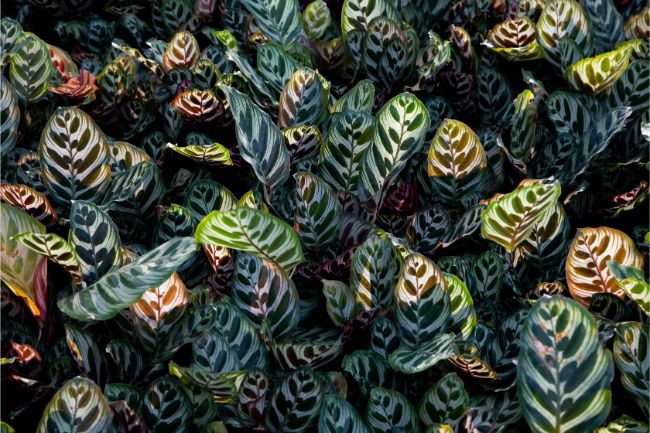
The Peacock plant, also known as Calathea makoyana, is a beautiful tropical houseplant, famed for its beautiful, contrasting green and purplish-red leaves that will brighten up any indoor living space. They do take a little bit of work to keep in good condition, so read on to learn all you need to know about peacock plant care.
How to care for a peacock plant? Calathea makoyana needs bright, indirect sunlight, temperatures of 60-75°F (16-24°C), and high humidity. Water when the soil surface starts to dry, fertilize with a dilute, balanced fertilizer every 2-4 weeks, and pinch back the stems to create a fuller, bushy plant.
Interested in learning more about peacock plant care? If so, keep reading! The following information covers the different aspects of caring for this stunning houseplant to keep it beautiful and healthy.
Calathea Makoyana Overview
As with many other houseplants, the peacock plant also has tropic origins which is one of the reasons it does so well indoors. It is native to the tropical forests of Brazil, found growing under the shade canopies of the tall, tropical trees.
The attractive foliage on the Calathea is what makes them popular with homeowners as houseplants. These tall, slender plants add beautiful color to your houseplant collection without monopolizing space.
Peacock Plant Care Needs
- Scientific Name: Calathea makoyana
- Common Name: Peacock Plant or Cathedral Windows
- Origin: Eastern Brazil
- Light Requirements: Bright, indirect light. Avoid direct sunlight.
- Watering: Maintain moist soil. Water once the surface of the soil starts to dry.
- Soil: Well-draining general-purpose houseplant potting mix.
- Temperature: 60-75°F (16-24°C) for best growth.
- Fertilizer: Use liquid or water soluble fertilizer made up at no more than half strength and apply every 2-4 weeks during the growing season. NPK 3-1-2 is perfect, but a balanced preparation is normally fine.
- Humidity: >60% humidity. High humidity is really important to keep your peacock plant healthy. Using a digital hygrometer to monitor humidity is a great idea.
- Pruning: Remove old leaves and pinch back to maintain compact growth.
- Propagation: Propagate by division in the spring or summer.
- Re-Potting: Repot every 1-2 years at the start of the growing season.
- Diseases and Pests: Generally quite resistant. Will get root rot if overwatered. Aphids, spider mites and scale sometimes.
- Toxicity: Non-toxic. Safe for humans and pets.
- Where To Buy: Buy Calathea makoyana online at Etsy (I buy most of my houseplants from Etsy).
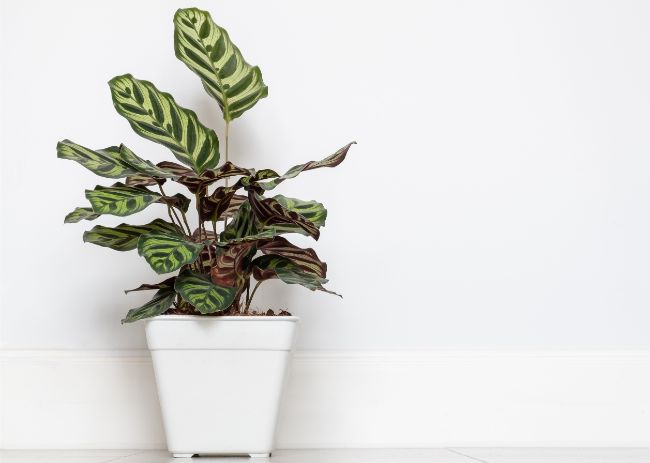
Characteristics Of The Peacock Plant:
- Grows up to two feet tall.
- Pale green leaves grow 10 to 12-inches long and have a dark green feathered effect from the middle of the leaf to the outer edge.
- Undersides of leaves are pinkish-maroon. New leaves look pink before they unroll.
Peacock Plant Growing Conditions
Given their tropical origin, peacock plants are typically grown indoors where the temperatures are steadily warm all year round, but peacock plants can be grown outside in certain growing zones. USDA Hardiness Zones 10A to 11 are warm enough to grow the plants outside under the canopy of other trees or shrubs.
When growing plants in your home, provide the following growing conditions to promote strong, healthy plants.
Light Requirements
Peacock plants are native to the tropical forests of Brazil, where they grow in the understory of the forest, where there is limited direct light at ground level. Because of this, they have lower light requirements than many other houseplants.
Place your peacock plant where it receives bright, indirect light. A north facing windowsill, or close to an east facing window will provide good light levels. In rooms that receive a lot of direct light, you can place your plant further from the window, or shield it from direct light with furniture, curtains or blinds.
Avoid putting your plants where they receive direct sunlight as this can cause bleaching of the leaves and brown tips.
Lower light conditions will result in slower plant growth, faded leaf color, and you may also see smaller leaves or large spaces between the leaves.
Peacock Plant Temperature Needs
Tropical houseplants do well indoors because they prefer the same temperature range as humans. For best growth keep your peacock plants in a room where temperatures are between 60°F-75ºF (16C°-24ºC), avoiding any sudden drops in temperature.
Keep your plants in a spot where they are not exposed to drafts coming from leaky windows, opening/closing doors, or register vents blowing heat in the winter and cool air in the summertime.
In cooler growing zones, plants can be taken outside during the warmer spring and summer months as long as nighttime temperatures don’t drop below 55°F (13°C), or you bring them indoors at night. Place them in a shaded location or under the canopy of trees or other plants to keep them out of direct sunlight.
Humidity For Peacock Plants
Peacock plants will thrive in homes with higher humidity especially where humidity levels are upwards of 60%. They do well in bathrooms if they can receive enough sunlight. The warm, moist air is reminiscent of their rainforest origins.
Humidity is one of the most important things to focus on to keep your Peacock plant healthy. If your plant is starting to show signs of brown leaf edges or tips, this is a sign of low humidity.
With calatheas, I think it is really important to monitor humidity levels to prevent any issues. I use a digital hygrometer, which allows me to adjust humidity levels as soon as I see them dropping.
To increase humidity, there are lots of options. Many people advise misting your houseplants, but this is far from the best way to reliably improve humidity. Try grouping your plants together, setting your plant in a tray containing pebbles and water, or use an electric humidifier.
I’ve written an article that looks at 10 ways to improve humidity that will help you improve humidity for your peacock plant.
Choosing Soil For Calathea Makoyana
Peacock plants like to have a growing media that holds a fair amount of moisture that quickly drains off excess water and provides good aeration to the roots. Most “all-purpose” commercial potting soils are suitable as they are formulated with those needs in mind. Be careful not to purchase potting soils specifically formulated for a given type of plant such as acid-loving plants or succulents; they have been formulated to meet a slightly different need.
Commercial potting soils are actually a “soilless” mix of peat moss, coconut coir, pine bark, and either perlite or vermiculite. Avoid using straight coconut coir or sphagnum peat moss in your containers; they retain too much water.
If you want to improve the drainage rate of the potting soil you purchase you can add extra perlite or sand. Simply mix the components together well in a larger bucket and then use the mix to fill your container when potting up your plant.
Watering Peacock Plants
Getting watering and humidity levels right are essential for good peacock plant care. The trick with watering is to keep the soil nicely moist, but avoid letting it get soggy.
I like to water my peacock plant once the top of the soil starts to feel a little dry. I usually take my plant to the sink and water it thoroughly until water runs freely from the drainage holes. I let it sit in the sink for a few minutes until all of the excess water has drained out, leaving nicely moist, but not soggy soil.
During the winter when plant growth slows, allow the top half-inch of potting soil in the container to dry out before watering your plant again. Yellow leaves indicate over-watering and brown leaves mean the plant needs more water.
Water with room temperature distilled water or collected rainwater. Fluoride in municipal water can damage plants. If you do opt to use tap water, let it sit for a couple of days to allow the chlorine in treated water to dissipate before using it to water your plants.
Read more about how to detect when your houseplants need watered in this article.
Fertilizer
Fertilize your peacock plant every 2-4 weeks from spring through to early Autumn, when the plant is actively growing. Grows slowly considerably during the winter months, so fertilizing during this time is not required.
Calatheas are quite sensitive to over-fertilizing, so err on the side of caution. Use a liquid or water soluble, fertilizer made up at half the recommended strength or less.
Ideally, you should use a fertilizer preparation that contains more nitrogen, with an NPK ratio of 3-1-2, as recommended here. However, in practice, I have had great results using this balanced fertilizer, with equal amounts of nitrogen, phosphorus and potassium.
Pruning
Unlike some houseplants, your Calathea doesn’t need much in terms of pruning. As the leaves age, they will periodically yellow or brown and then die. Trim off dead leaves with a pair of sharp, sterilized scissors, cutting them off where they join the main stem or at the soil level.
You may also like to prune your Calathea makoyana to maintain a more compact, bushy growth habit.
Re-Potting
Your peacock plant should be repotted to a slightly larger container every 1-2 years, preferably in the springtime or early summer. Springtime is the best time to repot plants as they begin actively growing after the cooler winter months, and can bounce back from the shock of repotting quicker.
When repotting add new potting soil or mix finished compost into the mix to “refresh” the nutrient content and organic matter. Make sure to loosen up the roots if they are rootbound. Also, when filling containers with growing media do not create a “drainage layer” in the bottom of the pot. For a long time, this was a highly recommended practice, taught to new gardeners. It’s been proven though that this practice is more detrimental than helpful.
As water moves down through the soil profile via gravity, it stops when it encounters this drainage layer created by rocks or small stones. Before the water percolates into the layer, the entire potting soil must fill with water rendering the layer problematic instead of beneficial.
Propagation
Peacock plants are propagated through division. When it is time to repot plants, carefully divide the crown and root ball into two or more sections. Then repot each section into its own new container with fresh potting soil.
Just after dividing plants, ensure the humidity is high until you see new growth.
Peacock Plant Diseases And Pests
Peacock plant care isn’t impacted too badly with disease and pest problems, although they do exist. As with many other houseplants, one of the biggest contributors to diseases and pests is overwatering so water plants only when they need it to help minimize infestations.
With both diseases and pests, monitor your plants frequently to catch problems early and then treat immediately to reduce the overall damage.
Diseases
The main diseases affecting Calathea plants are root rot and Pseudomonas leaf spot.
Root Rot
The most commonly seen problem with peacock plant care is root rot, caused by overwatering, especially in the winter months. The roots then die back due to lack of oxygen or the overgrowth of a soil fungus. Soggy soils encourage the growth and multiplication of Pythium, Phytophthora, Rhizoctonia, or Fusarium fungi which spreads into the roots, infecting plants.
Healthy roots begin to turn brown and mushy as they perish, unable to take in nutrients needed for growth. As root rot progresses leaves turn yellow, wilt, or droop and then become mushy as well. Once symptoms are visible in the leaves the problem may be past the point of rectifying, endangering the entire plant.
The challenge with root rot is that it often goes unnoticed because it occurs beneath the soil surface and out of sight. In extreme cases when conditions are perfect, i.e. in pots without drainage holes, root rot can kill the whole plant within ten days.
If caught soon enough you can repot the plant, to try to save it. Remove as much of the infected soil as possible adding in fresh, clean potting soil. If root rot has spread significantly, dissect the plant, keeping only the healthy portions. If the whole base is affected, take stem cuttings from healthy foliage to propagate a new plant.
Pseudomonas Leaf Spot
A bacterial disease, pseudomonas leaf spot causes reddish-brown spots on the leaves that may cause leaf distortion.
You can help prevent leaf spot by keeping the foliage dry when watering. If leaf spot appears, remove the affected leaves and treat the plant with a copper-based bacteriacide.
Insect Pests
Insect problems are more of a challenge with peacock plant care, mainly if you have neighboring houseplants with aphids, spider mites, or scale.
Aphids
Aphids are one of the most common insects affecting indoor plants. These tiny, pear-shaped insects attach themselves to the plant, sucking sap from the plant tissues, and then secreting “honeydew”. Symptoms appear as distorted foliage and leaf drop.
Remove aphids by wiping the plants with a clean, soft cloth or spraying the plants with a mild solution of water containing a few drops of dish soap.
Spider Mites
These tiny sucking pests are found on the undersides of leaves, wreaking havoc on indoor houseplants. Spider mites feed on the fluids found inside the leaves of the peacock plant, piercing the waxy coating to access the internal fluids.
One of the biggest challenges with spider mites is their prolific nature; oftentimes a heavy infestation will occur, unnoticed, before plants begin to show physical symptoms of damage.
With an infestation of spider mites, leaves may be stippled with discoloration or turning yellow overall. Plants may also exhibit a fine, spider-like webbing between the leaves or at the base of the plant.
Scale
Scale is a threat to most species of shade and fruit trees, ornamental shrubs, and houseplants. The pests pierce leaves, stems, branches, and tree trunks to feed on the sap within these plant tissues, damaging the plant overall.
There are two different types of scale insects that infest peacock plant: soft and armored scale. Both appear as little brown bumps on the leaves with the soft scale being more prevalent. Insect sizes range from ⅛ to ½ inch in length; color, shape, and texture vary amongst different species.
Soft scale insects do not possess a hard, protective coating so they generate either a thin, powdery, cotton-like or waxy layer over their bodies for protection. These layers cannot be separated from the insect body.
Armored scale, on the other hand, creates a hard shield-like layer from shed skins and wax to protect themselves from natural predators and chemical insecticides. This layer can be separated from the insect body and tightly adheres the scale to the plant forming a waterproof seal.
Besides the notorious leaf drop, plants infected with scale exhibit yellowing leaves. The yellow spots appear on the tops of the foliage while the insects suck sap and chlorophyll from the bottom. Leaves may wilt, become stunted, and you may see decreased vigor overall in the plant.
I’ve written an article about the best ways to get rid of houseplant bugs naturally. This covers the best ways to get rid of a range of houseplant pests using natural remedies that really work very well.
Peacock Plant Care Problems And Questions
Do Peacock Plants Flower?
- Yes, peacock plants flower, but not frequently or in a showy manner. Tiny white flowers may be periodically seen peeping through pale green bracks on mature plants throughout the year, but they are insignificant.
Are Peacock Plants The Same As Prayer Plants?
- Peacock plants are a type of prayer plant, but there are many other plants that are commonly known as prayer plants. Many houseplants within the Marantaceae family, including plants within the calathea ctenanthe, maranta and stromanthe genera are known as prayer plants. The key feature of these plants is leaves that fold up at night, hence the name prayer plants since they look like hands folded in prayer.
Are Peacock Plants Toxic?
- No, peacock plants are not toxic to pets or humans. There is little to no risk if the foliage from a calathea plant is accidentally ingested.