Something extraordinary just happened.
Something that has left scientists scratching their heads and rethinking everything they know about interstellar objects.
For months, astronomers had been monitoring the arrival of 3I/ATLAS, a mysterious object from another star system.
At first, it seemed like just another comet, another icy visitor passing through our solar system.
But then, as the object neared perihelion — its closest point to the Sun — things took an unexpected turn.
What was supposed to be a routine observation turned into a dramatic explosion of data that no one saw coming.
Before we begin, smash the like and subscribe buttons for more updates on this shocking discovery.
An Ancient Traveler from Beyond
First, let’s step back and understand just how special 3I/ATLAS is.
Discovered on July 1, 2025, by the ATLAS survey system, this object is only the third interstellar visitor ever confirmed.
The first, ʻOumuamua, caused a stir with its strange shape and unexpected acceleration.
The second, Borisov, appeared more like a typical comet, albeit from another star system.
But 3I/ATLAS had been predicted to behave like other comets, following a hyperbolic trajectory, and heading back into deep space after its flyby.
However, this comet had other plans.
A Brightening Mystery
As 3I/ATLAS passed near the Sun, something strange happened.
Instead of gradually brightening as comets typically do due to the Sun’s heat, it blazed up far brighter than expected.
Its sudden brightness surged at a rate 40 times higher than just a month earlier, catching scientists completely off guard.
This isn’t how comets behave.
Normally, as a comet approaches the Sun, the process of sublimation occurs slowly, with water vapor and gases gradually leaking out.
But 3I/ATLAS behaved differently.
It went from a faint glimmer to an intense burst of light in a matter of hours.
Astronomers were left to ask: What could cause this sudden outburst?
The Explosion at Perihelion
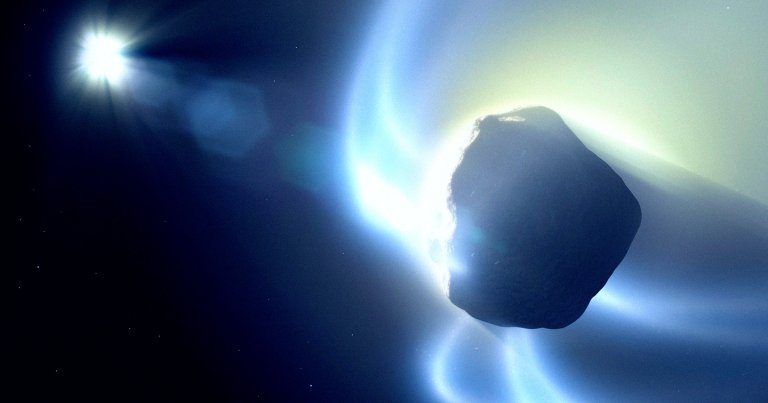
The situation became even more baffling when 3I/ATLAS passed its closest approach to the Sun — perihelion — on October 29, 2025.
Instead of continuing its predicted trajectory, the comet appeared to “pause”.
It didn’t move the way scientists expected.
Instead, its motion seemed to stall, almost as if it had become stationary in space.
This caused a stir within the scientific community, leading to immediate scrutiny of every available data point.
NASA’s Jet Propulsion Laboratory and other observatories worldwide tried to make sense of what was happening.
Was it a glitch?
Was there an issue with the instruments?
Or was 3I/ATLAS really defying the laws of physics?
The Data Doesn’t Lie — Something’s Not Right
Every analysis of the data confirmed that something unnatural had occurred.
The object was still moving, but it wasn’t behaving the way a typical comet should.
This wasn’t just a comet outgassing in an irregular way.
This was something else.
3I/ATLAS was not emitting any significant dust like most comets.
Instead, it was emitting massive bursts of gas that didn’t match any cometary model known to science.
The intensity of this outgassing made it appear as though the object had some hidden internal source of energy.
The Hidden Energy Source
As the data from NASA’s James Webb Space Telescope (JWST) came in, it revealed even more astonishing details.
3I/ATLAS was not only brighter, but also releasing an energy signature that couldn’t be explained by typical cometary behavior.
In particular, high levels of carbon dioxide (CO2) were detected in the comet’s coma.
This was highly unusual, as most comets have more water vapor than CO2 in their emissions.
The CO2 levels in 3I/ATLAS were far greater than any comet seen before.
This anomaly suggested that something on the surface of the comet was reacting to solar radiation in a way that no known comet had ever done.
Could it be more than just a comet?
Could it be a machine?

Theories — What Could 3I/ATLAS Be?
As the data continued to accumulate, the possibilities began to expand.
Could this interstellar visitor actually be a relic of a long-lost civilization?
The idea of alien technology hidden in plain sight started to take root.
Some scientists theorized that 3I/ATLAS could be a probe, sent by an intelligent species to study our solar system.
The possibility that this object was artificial — a dormant, yet active, relic of a civilization beyond our own — could explain its unexpected activity.
The Planetary Defense Protocols
By October 21st, 2025, the situation escalated.
The International Asteroid Warning Network (IAWN), an organization that monitors potential threats to Earth, activated planetary defense protocols for the first time in history.
They were preparing for a close encounter with an interstellar object that had displayed unpredictable behavior.
It was a first-ever instance where an interstellar object became a subject of concern for planetary defense.
The Hidden Force — A Mysterious Power Surge
By now, there was no denying it.
3I/ATLAS was behaving like nothing we’ve ever seen before.
Not only had it undergone a dramatic brightness surge, but the object also exhibited an acceleration that couldn’t be explained by gravity alone.
According to NASA’s Jet Propulsion Laboratory, the acceleration was in two components: one pushing away from the Sun, and another that was perpendicular to this direction.
This unnatural acceleration was now well-documented, with no clear cause.
Normal outgassing from a comet would never produce this kind of result.
The obvious question emerged: What kind of force is at play here?

What’s Behind This Surge?
The surge in brightness, outgassing, and unexpected acceleration could only be explained by one thing:
An external force.
Perhaps 3I/ATLAS was powered by something not of this world.
Could there be advanced technology embedded in this object, waiting to be discovered?
Is this a craft sent to observe or communicate with us, or perhaps an ancient artifact from a long-dead civilization?
The Impact on Science
The implications of 3I/ATLAS cannot be understated.
This isn’t just another comet.
It’s evidence that the universe may be far stranger and more complex than we ever imagined.
If it’s a natural object, the universe holds deep mysteries beyond what we thought possible.
If it’s an artificial object, it could revolutionize our understanding of interstellar technology.
For scientists around the world, the challenge is now clear:
We must determine whether this object is a natural phenomenon or a technological relic.
The Timeline Ahead — December 19th, 2025
The world now watches as 3I/ATLAS continues its journey through our solar system.
December 19th, 2025 is marked as the date of closest approach to Earth, and with that, scientists expect a final test to see if the expected gas cloud around the object is visible.
If no cloud appears, it will confirm that something engineered is behind the comet’s acceleration.
For now, all eyes are on December 19th.
That’s when everything will be revealed.
Conclusion: A New Frontier
3I/ATLAS has opened a new chapter in interstellar exploration.
Its behavior raises questions that no previous object has ever stirred.
Is it just an anomaly of nature?
Or is it a message from a civilization far older than ours?
In the coming weeks and months, we will be one step closer to understanding the true nature of this interstellar visitor.
The data continues to pour in, and with each piece, we move closer to uncovering the mystery.
If you liked this video, please give it a like and subscribe to our channel.
Also, leave your comments below and tell us what your thoughts are on 3I/ATLAS and the secrets it holds.
We want to hear from you.
Thank you for watching, and see you next time.