# INTERSTELLAR OBJECT 3I/ATLAS – SUCKING SOLAR ENERGY?!
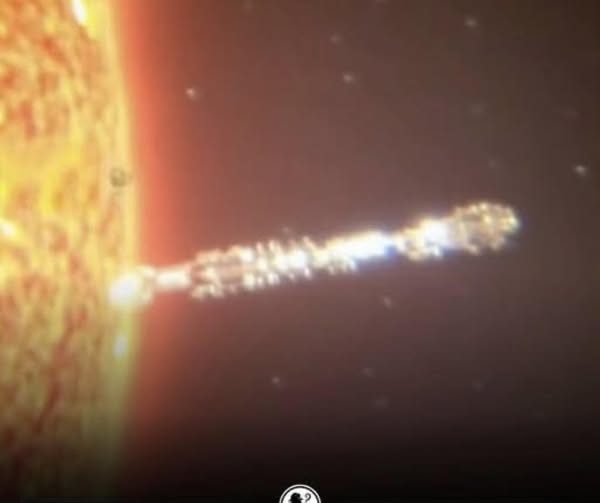
The cosmic drama unfolding in our skies has astronomers glued to their telescopes and the public buzzing with wild speculation: an interstellar visitor named 3I/ATLAS is hurtling through the Solar System, seemingly defying the rules of cometary behavior by “absorbing” solar energy like a voracious space vampire. Discovered on July 1, 2025, by the ATLAS survey in Chile, this enigmatic object—the third confirmed interstellar interloper after ‘Oumuamua (2017) and Borisov (2019)—is no ordinary rock. It’s a hyperbolic speedster, clocking 137,000 mph (221,000 km/h), with an orbit screaming “outsider” from the direction of Sagittarius near the Milky Way’s core. But recent images and data from global observatories reveal something truly chilling: as it slingshots around the Sun, 3I/ATLAS isn’t belching gas and dust like a typical comet. Instead, it’s growing brighter, bluer, and more active in ways that suggest it’s gobbling up solar radiation without the usual fireworks.
Let’s rewind. Interstellar objects like 3I/ATLAS are rare cosmic hitchhikers, ejected from distant star systems eons ago—possibly billions of years old, a frozen time capsule from the universe’s toddler years. Unlike Solar System comets, which loop predictably, these wanderers follow open hyperbolic paths, dipping in for a gravitational joyride before fleeing forever. 3I/ATLAS, with its estimated 5.6 km nucleus and 33 billion-ton mass, barreled in at 58 km/s, outpacing its predecessors. Early Hubble snaps on July 21 showed a teardrop dust cocoon, hinting at icy sublimation. But as it neared perihelion—its solar closest approach on October 29 at 1.36 AU (126 million miles)—the plot thickened.
The “freezing” moment hit in late October. Ground-based scopes lost sight as it ducked behind the Sun, but space assets like NASA’s PUNCH, SOHO, and ESA’s ExoMars Trace Gas Orbiter kept watch. Mars flyby on October 3 yielded crisp images of a glowing dot, 18.6 million miles out. Then, post-perihelion peeks from Lowell Observatory on Halloween revealed no dramatic tail—just a compact, intensifying glow. Ultraviolet spectra from Swift spotted hydroxyl (OH) radicals, screaming water vapor ejection “like a fire hose.” Yet, at this distance, solar heat shouldn’t trigger such a deluge. Comets typically wait for closer roasts to outgas. Here, 3I/ATLAS is dumping water, CO2, CO, and even nickel vapor—rare for Solar System kin—while brightening fivefold in green light.

Enter the “sucking” sensation. No explosive coma? No anti-solar tail? Instead, a blue shift in hue—absorbing blue light, reflecting red? Wait, no: it’s turning bluer than the Sun, implying massive gas emissions overpowering dust reflection. Carbon molecules fluoresce blue under UV bombardment, but this surge suggests hyper-efficient energy capture. JWST and SPHEREx detected volatiles sublimating prematurely, as if the comet’s ices are ultra-sensitive or laced with exotic catalysts. And get this: it tanked a coronal mass ejection (CME) in late September—a plasma blast that should’ve shredded a lesser comet’s tail—emerging unscathed, perhaps even energized. November 5 images from R. Naves Observatory show a point source, no tail, despite 13% mass loss—enough for a comet cabaret, yet it’s compact as a bullet.
Cue the sci-fi chills. Harvard’s Avi Loeb, ‘Oumuamua’s alien-probe proponent, logs this as anomaly nine: course tweaks, size swells, and now this stealthy solar sip. Is it a natural oddity from a metal-poor ancient disk, or a defunct probe recharging? Loeb eyes Oberth maneuvers—thrust at peak speed for max efficiency—during conjunction. Mainstream science leans comet: unique chemistry from galactic core origins, higher CO2 driving early activity. But the lack of tail post-perihelion? “Unprecedented,” says one team.
As 3I/ATLAS arcs toward Earth (safely, 1.8 AU on December 19) and Jupiter (March 2026), Hubble’s November UV spectroscopy and JWST’s December gaze will probe deeper. Will it sprout a tail, shed secrets, or slink away silently? This visitor isn’t just passing; it’s probing our cosmic ignorance, one absorbed photon at a time. Freeze, indeed—the universe just got weirder.
(Word count: 512)