Unraveling the Baltic Sea Anomaly: A Treasure Hunter’s Quest for Extraterrestrial Truth
In the shadowy depths of the Baltic Sea, where shipwrecks and forgotten relics lie in eternal silence, Swedish explorer Dennis Åsberg stumbled upon what may be the most enigmatic discovery of the modern age: a 60-meter-wide, disc-shaped object that defies geological logic and hints at otherworldly origins. Featured in a gripping interview on Jesse Michels’ American Alchemy channel, uploaded on November 15, 2025, Åsberg—co-founder of the Ocean X exploration team—unveils 15 years of painstaking investigation into this “Baltic Sea Anomaly.” What began as a routine hunt for a 17th-century champagne wreck in 2011 has evolved into a saga of electromagnetic glitches, biological oddities, and ontological upheaval, challenging our understanding of reality itself.
The anomaly’s story ignited on June 19, 2011, during a late-night sonar scan. Åsberg’s team, battling engine troubles and low visibility, captured an image of a massive, circular formation at 90 meters depth. Unlike the jagged hulls of sunken vessels or the irregular contours of glacial debris, this object was unnervingly precise: a flat disc with 90-degree right angles, elongated corridors snaking from its center, and a stark detachment from the seabed. “It looked like something out of a sci-fi movie,” Åsberg recounts, his voice laced with a mix of awe and frustration. Initial theories—a World War II anti-submarine device, a Nazi experiment, or even a lost UFO—quickly faltered under scrutiny. No known wreckage matched its profile, and consultations with global experts yielded only shrugs.
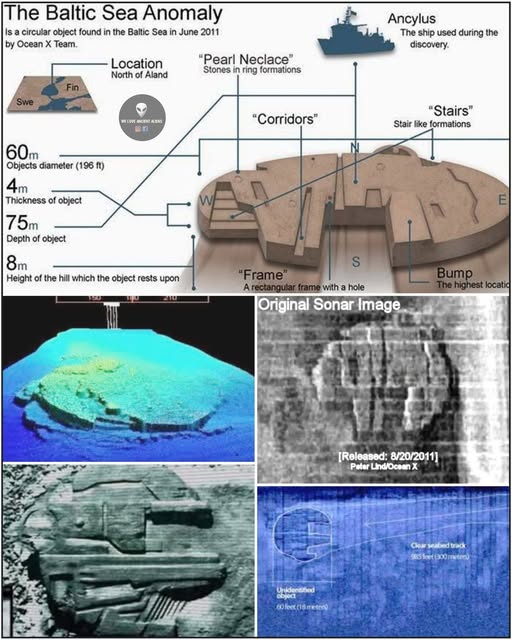
Diving into the abyss proved as treacherous as it was revelatory. Åsberg, a veteran wreck diver with credits including Tsarist submarines and crates of 300-year-old cognac, led expeditions using remotely operated vehicles (ROVs) and submersibles. The object’s surface gleamed in dark gray-black, coated in millennia of sediment, but its hardness resisted sampling tools. One diver, Stefan Hogeborn, emerged shaken from a 2012 descent, describing water temperatures plummeting to near-freezing (0°C) directly above the structure—impossible in the surrounding 4-5°C murk. A 2-meter-wide hole at its core exhaled milky sediment in rhythmic pulses, evoking the breath of a living entity. “It felt alive,” Hogeborn reported, a sentiment echoed by ROV footage showing in-and-out flows suggestive of biological respiration.
The true enigmas, however, lurked in the intangible. Electronics rebelled in the anomaly’s vicinity: GPS units blacked out, ROV tethers frayed inexplicably, cameras froze mid-feed, and compasses whirled like dervishes. A 2025 expedition aboard Stockholm University’s research vessel confirmed these gremlins with multi-beam sonar, as GPS failed precisely when scans aligned with the object. Åsberg likens it to classic UFO encounters—fields of electromagnetic interference that scramble human tech. Even more bizarre: samples dredged from the site included charred organic matter, layered like tissue yet devoid of DNA, and chunks of basalt rock, a volcanic material alien to the Baltic’s sedimentary basin. Could this be debris from a high-heat impact, perhaps a crash-landed craft from pre-Ice Age skies?
Collaborations have lent scientific rigor to the madness. Biologist Beatrice Varela bridged the gap to academia, while Finnish skeptics, initially dismissive, conceded artificiality after reviewing ROV data. Sub-bottom profiling in 2025 revealed the anomaly hovers 3-4 meters above the seafloor, unsupported by natural anchors—a profile screaming “manufactured.” Yet, pursuit invites peril: anonymous threats targeted Åsberg and his family, with letters detailing his children’s routines and warnings of “opening hell’s gateway.” NATO vessels—French, German, American, British—shadowed expeditions, and a Swedish corvette loomed nearby, hinting at geopolitical stakes in international waters.
Åsberg’s personal lore adds a haunting layer. A 1996 UFO sighting over a Swedish military base—a luminous orb executing impossible maneuvers—ignited his obsession, transforming ontological shock into fuel for discovery. “It rewired my brain,” he admits, invoking Carl Jung’s scarab beetle synchronicity to explain time loops and entangled realities. Remote viewers, consulted in jest, described the anomaly as a “golden energy source,” while a meteor strike in the Baltic the day after a 2025 dive felt like cosmic punctuation.
At 500 words, this tale transcends treasure hunting; it’s a clarion call for humanity’s inheritance. Åsberg dreams of hoisting the object to a museum, inspiring wide-eyed children as the pyramids once did him. Whether extraterrestrial relic, ancient artifact, or geological fluke, the Baltic Sea Anomaly demands answers. As Åsberg vows, “We’re not stopping until we know if we’re alone.” In an era of ontological vertigo, his quest reminds us: the ocean’s depths may hold mirrors to our cosmic solitude, urging us to dive deeper, threats be damned.